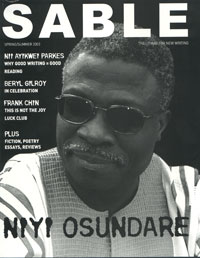
Why Writers Should Read
(unedited)

For me the whole practice of writing is similar to what a dancer practises on a dance floor. A good dancer, like a good writer, interprets. She/He takes in the song, filters its elements through her/his experiences, capabilities, peculiarities, and translates it into motion. With writers, the song is life and the motion is words. In some cases, it appears the similarities end here. I hear too many writers – especially poets – saying that they don’t read other people’s work because it could affect their style. Crazy? In truth I have held such sentiments before. There’s no denying reading other people’s work will affect our writing. But, unless we read narrowly, it won’t permanently affect our style. A truly unique voice must be able to withstand exposure to the influence of other voices. And, to be honest, I feel that it is worth putting our style at risk to find its purest essence.
How can we fully evolve as writers without exposing ourselves to some of the great writing that is available to explore; Saul Bellow’s tight characterisation, Sonia Sanchez’s unique rhythm, Wole Soyinka’s unfailing accuracy, Pat Conroy’s effortlessly poetic voice, and Yates’ mastery of form. And that’s without even going back to the so-called classics.
The reluctance or fear of some of our generation of writers to read stems from the manufacturing line speed exposure a writer gets in these times. Because it is possible to get our work on the internet within minutes of our writing it, or to read in front of an audience within hours of conception, we very quickly get into a phase where we’re defending our work. Once there’s an audience, we have to appear sure of what we are saying. We’re instantly thrust into a star/hype cycle and it’s hard to get out. It doesn’t matter that we haven’t had time to determine how original our ideas are, or how well we they are presented. Contrary to what we may feel, only a small percentage of our experiences in life are truly unique. If we don’t read, there is no way of knowing if what we are writing about has been tackled before, in what context, and how well it was written. So what if after reading Shakespeare you find that you are spouting sonnets? Then read Nikki Giovanni, and after that read Graham Greene and keep writing! After an unavoidable period of sounding like the people you are reading, your own voice will emerge. Your writing will be clearer simply by your having found points of disagreement in the books you’ve read. Reading gives you the latitude to detach yourself from your own work. Finding a corny, unoriginal love story by a writer you respect can give you the impetus to admit that your love story is pretty corny too. Personally, I admit to editing work by the accepted greats in the privacy of my bedroom. Great doesn’t mean infallible right? Just doing that makes me feel better about editing my own work. It’s like a dancer deciding not to look like Michael Jackson – it’s not that hard to relate to!
Read because when it comes down to it, everything around us is an influence; music, dance, poverty, violence, conversation… Unconsciously we filter these influences and still manage to express ourselves as individuals. Reading shouldn’t be any different. What we read should inform us without necessarily reforming our style or voice. And what’s the point of style without content? I’d hate to see writing fall into the same pit hip-hop is now trying to climb out of. A cesspool where the focus has swayed so much towards looking good, that a lot of the lyrics have become largely about looking good. Even skilled practitioners of the art like Nasir Jones have found themselves falling into the image trap. To Nas’s credit, he has returned to the drawing board and rediscovered himself. He took time out and came back fresh.
Now I’m not saying that reading is the only way to improve our writing or to become more aware of the world, but it does offer a means of developing an analytical eye so that we can be more critical of our own work. It also heightens our appreciation of voice. It is nothing to fear. It’s true that when you read someone else’s voice inhabits your head for a while. Sometimes, their sentence structure imposes itself on your subconscious. It can be mildly unsettling. However, the truth is, not everything we ever write will be published. So even if we feel reading might lead to our compromising our style, we should read regardless, write our way through a good chunk of crap until the kind of work we dream of writing comes flowing through, and then get back in the public arena. Despite the disquieting feelings it may evoke in a writer keen to hone his/her voice, reading is an adventure that we as writers should approach with relish.
The last thing I mean to do is advocate rules for writers to follow. I don’t believe in rules. Writing would be a boring endeavour if we all stuck to formulae and conventions. However, I do believe that it is important to know what has been done before as well as what is being done in order to be able to leave a unique mark on the world. A true guerrilla studies the ruling party, masters its defence strategy, its cycles, and infiltrates its systems before attempting to take it down. We must learn the rules, and then break them. As we read, we must think of how we feel as readers and think about how the writer evoked those feelings in us. Is there something we could learn from that? In this way reading becomes a sweet multi-layered experience where we’re entertained, taught and inspired all at once.
In the absence of more exciting methods of informing ourselves, like time travel and teleportation, reading seems a sensible approach to getting to know all there is to know in the little time we have.
So writers, combat the fear. Read.
home | diary | bookings | publicity | books | poetry | thoughts
content © Nii Ayikwei Parkes 2001 - 2003.